




Six general characteristics of concrete cracks
 Apr 16, 2025|
Generally, they occur during the concrete pouring process or after pouring and before the initial setting of the concrete. Because the aggregate in the concrete mixture slowly sinks under the action of its own weight, the water floats upward, which is the so-called bleeding.
If it is plain concrete, the internal sinking of the concrete is uniform. If it is reinforced concrete, the concrete continues to sink under the steel bars, and the concrete above the steel bars is supported by the steel bars, causing the concrete to crack along the steel bar surface. This kind of plastic collapse crack is particularly serious for highly fluid concrete or concrete with a large water-cement ratio.
1. Plastic collapse crack
Generally, they occur during the concrete pouring process or after pouring and before the initial setting of the concrete. Because the aggregate in the concrete mixture slowly sinks under the action of its own weight, the water floats upward, which is the so-called bleeding. If it is plain concrete, the internal sinking of the concrete is uniform. If it is reinforced concrete, the concrete continues to sink under the steel bars, and the concrete above the steel bars is supported by the steel bars, causing the concrete to crack along the steel bar surface. This kind of plastic collapse crack is particularly serious for highly fluid concrete or concrete with a large water-cement ratio.
▲ General characteristics of cracks: concrete cracks along the surface of the steel bar
2. Plastic shrinkage (shrinkage) cracks
Generally, cracks are generated after concrete is poured and is still in a plastic state due to hot weather, large evaporation, strong winds or high hydration heat of the concrete itself.
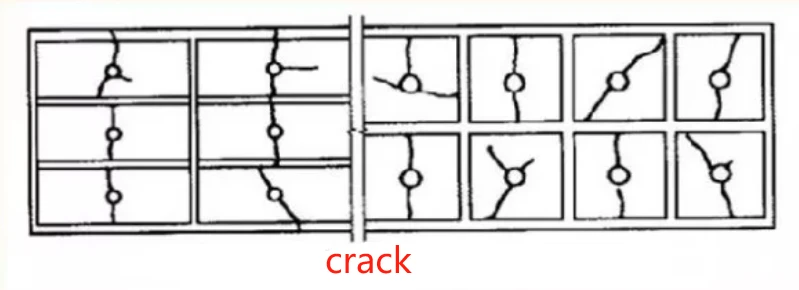
▲ General characteristics of cracks: Generally, there are two shapes, one is irregular turtle-shaped or radial cracks; the other is a crack that appears at a certain distance; sometimes the above two types of cracks appear on the concrete member at the same time.
3. Temperature cracks
Generally, it is due to changes in external temperature that cause concrete to expand and contract. This deformation is temperature change. When the concrete member is constrained, stress will be generated in the concrete member. When the tensile stress generated in the concrete exceeds the tensile strength limit of the concrete, the concrete will produce temperature cracks.
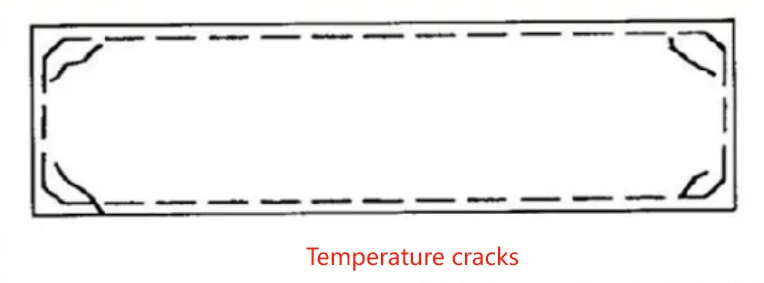
▲ General characteristics of cracks: Temperature cracks, due to the different temperature field distribution, temperature difference, degree of constraint and type of structural member, the shape and location of temperature cracks are quite different. At the same time, over time, temperature cracks will gradually develop and even worsen. Temperature cracks are a more complex type of concrete cracks.
4. Hydration heat cracks
Generally, they occur during the construction of large-volume concrete or high-strength concrete. Due to the high heat of hydration of concrete, the temperature inside the soil is quite different from the temperature of the concrete surface and the temperature of the external environment, and there are constraints on the existence of hydration heat cracks.
▲ General characteristics of cracks: There are surface cracks, internal cracks, bottom cracks, through cracks, non-through cracks, and thermal stress concentration cracks at corners, cross-section mutation sites, and hole corners. In terms of the shape of the cracks, there are tortoise cracks or radial cracks, horizontal cracks, vertical cracks, oblique cracks, etc.
5. Foundation settlement cracks
Generally speaking, when the main body of the concrete structure and the foundation stiffness are large, its ability to resist foundation settlement is still strong. However, when the foundation treatment does not meet the requirements of the specification, especially in poor sites such as severe collapsible loess, frost heaving soil, expansive soil, saline soil, and weak soil, foundation settlement (expansion) cracks are still often produced.
▲General characteristics of cracks: Foundation settlement cracks have the characteristics of heavy bottom layer, light upper layer, heavy outside, light inner wall, heavy opening wall, light solid wall, etc., and most of them are oblique cracks, and a few are vertical and horizontal cracks. Foundation settlement cracks first appear on concrete beams, or at the junction of beams and columns. When the upper main structure has a large rigidity, horizontal cracks sometimes appear at the independent foundation and column roots.
6. Stress concentration cracks
Generally, they appear after the main structure is built. Concrete structure stress concentration cracks are mainly distributed in door and window openings, plane or vertical protrusions and recesses, open structure openings, structural stiffness mutations, and concentrated loads. For prestressed reinforced concrete structures, cracks are generally generated at the local compressive stress concentration generated at the anchor end of the tensioned steel bar.
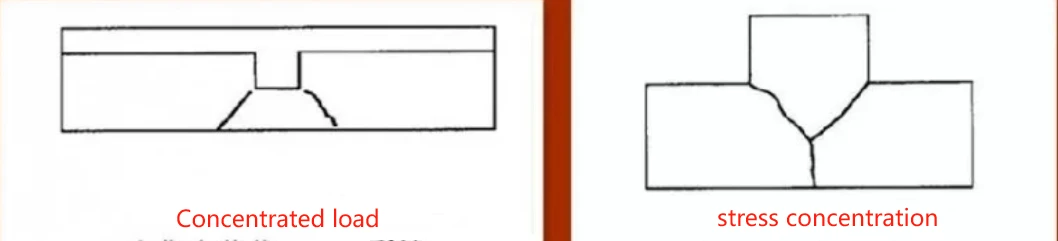
▲General characteristics of cracks: Stress concentration cracks generally occur at the corners of door and window openings and at the corners of flat and vertical protrusions and recesses, and oblique wedge-shaped cracks are the majority. In areas with large concentrated loads, splitting cracks are prone to occur. Sometimes, one or several cracks appear in the local pressure-bearing area of the anchoring end of the prestressed structure in a radial shape.