

 Language
 Language
Quick transportation
We cooperate with professional sea shipping, air and logistics companies to provide you with the best transportation solution.
Good services
Customer service will update you the logistics information of the goods in time to ensure that the goods are delivered in time.
Professional team
We have a team of skilled and experienced professionals who are well-versed in the latest technology and industry standards. Our team is dedicated to ensuring that our customers get the best service and support possible.
Competitive prices
We offer our products at competitive prices, making them affordable for our customers. We believe that high-quality products should not come at a premium, and we strive to make our products accessible to all.
Rich experience
Has a long-standing reputation in the industry, which makes it stand out from its competitors. With over many years of experience, they have developed the skills necessary to meet their clients' needs.
High quality products
We always put customer needs and expectations in the first place, refine on, continuous improvement, to seek every opportunity to do better, to provide customers with their expectations of quality products, to provide customers with the most satisfactory service at anytime.
Precautions for the Use of Armored Joints
During the use of armored joints, in order to ensure their normal operation and power safety, special attention should be paid to the following points:
1. The installation of armored joints must be carried out in accordance with relevant regulations and the manufacturer's installation instructions, and the operator must have relevant qualifications and operating skills;
2. The outer shell of the armored joint must have waterproof, anti-corrosion, explosion-proof and other properties to ensure its safe operation;
3. The selection of armored joints must consider many factors such as the cable model, specification, current load, and use environment to ensure service life and safety and stability;
4. The armored joints should be inspected and maintained regularly during use. If a fault is found, it must be handled in time to avoid power accidents caused by delays;
5. During the storage and transportation of armored joints, attention should be paid to moisture-proof and sun-proof to avoid damage or failure.
Matching halves must have temporary locating devices to provide stability during construction and accuracy across and along the joint when in service. These devices should be removed during construction or be self-separating. Inaccuracies are not easily remedied after construction.
Anchorage fittings such as shear studs need to provide adequate stability without creating planes of weakness in the concrete close to the joint. They should extend to the full length of the joint and be provided close to the ends of each rail and near to joint intersections. In addition, consideration can be given to welding the armouring sections at corners and intersections on site or by the use of prefabricated sections. However it is important to ensure that at intersections, all four corners are free from connection to each other. It must be possible to compact the concrete fully under and around the anchorages and any other steel sections used for load-transfer mechanisms.
1. It has formwork function. During construction, there is no need for additional support formwork. Each sub-warehouse of the floor is divided by installing the system: there is no need to remove the formwork after the floor is poured, and the construction is efficient, saving a lot of labor and time.
2. It has the function of concrete floor corner protection. The bent steel plate/floor corner protection flat steel is anchored into the concrete to protect the fragile concrete edges at the expansion joints of the concrete floor, and has super high durability: During the entire design life of the building, the post-maintenance cost is almost zero, which greatly reduces the post-maintenance work.
3. It has the function of integral force transmission, using the discontinuous force transmission plate with sheath, under the action of vertical load, the load can be transmitted from one side of the expansion joint to the other side. In addition, it also makes the sub-storey floors on both sides of the expansion joints, in the case of uneven settlement of the foundation, always coordinated and maintained at the same level, and there will be no uneven steps on both sides of the expansion joints.

Steel Armour Joints for edge protection of construction joints is provided by us for protecting construction joints against spalling or breaking.We use steel armoured joints at construction joints mostly falling in the gangway area where the arris or edges of the construction joints are vulnerable to damage when trafficked by Material Handling Equipment (MHE). To prevent this damage to the joints the construction joint is armoured.
Steel armour joints consist of strips 40 (Depth) x 8mm (wide). The armour is fixed into the slab with shear studs, which are welded to the steel strips. Below the armoured strips is a sheet of steel that acts as permanent formwork. It is within this formwork that plate dowels are typically pre-installed to act as load-transfer mechanisms at the joint. For the armour to be effective, it must be sufficiently stiff and well bonded to the concrete to resist and distribute the impact forces from the MHE.
For the best effectiveness, these joints are located as far as possible in high traffic zones. We supply & fix Steel Armour joints with 8mm thick anchorage dowels at day end joints, complete all as per global specification. Steel armour joints are fixed making use of high height fixing jacks.
Steel Armoured Joints are used for protecting construction joints against spalling or breaking. It is used for heavy-duty applications on jointed floors with saw cuts and joint-less SFRC or mesh reinforced ground bearing slabs. It can perform well up to 30 mm joint opening. This ensures smooth and even load transfer across the floor panels.
Choosing the proper armour joints in the construction industry is a critical selection that immediately influences the sturdiness and performance of a building's floors. Here isa concise manual tailored to factors including
Building Use
Consider the primary purpose of the building. Unique makes use of, which include residential, commercial, industrial, or institutional, include unique needs at the floors. Forinstance, industrial spaces can also require armour joints able to withstand heavy loads, while commercial spaces may additionally prioritise a balance between sturdinessand aesthetics.
Traffic Levels
Evaluate the expected faot and vehicle in the construction. High-traffic areas, like entryways and corridors, require sturdy armour joints to stand up to constant use. Considerjoints with excessive resistance to wear and tear in areas in which foot traffic is excessive and people with improved load-bearing capabilities in zones with heavy machinery.
Hazards and safety
Examine potential risks that the flooring may be exposed to, consisting of chemicals, moisture, or intense temperatures. Pick armour joints offer resistance to those dangersto ensure the protection and structural integrity of the construction. This is particularly crucial in industrial settings in which exposure to corrosive substances can bepredominant.
Floor Construction
The type of floor production is a substantial element. Whether or not you have concrete, tile, or other flooring substances, compatibility with the chosen armour joints iscrucial. Consider joints that combine seamlessly with the selected floor fabric and construction techniques, ensuring an invulnerable and long-lasting bond. By tailoring yourpreference to these elements, you can ensure that the armour joints not only meet the immediate needs of the task but also make contributions to the general resilience andsafety of the development through the years.
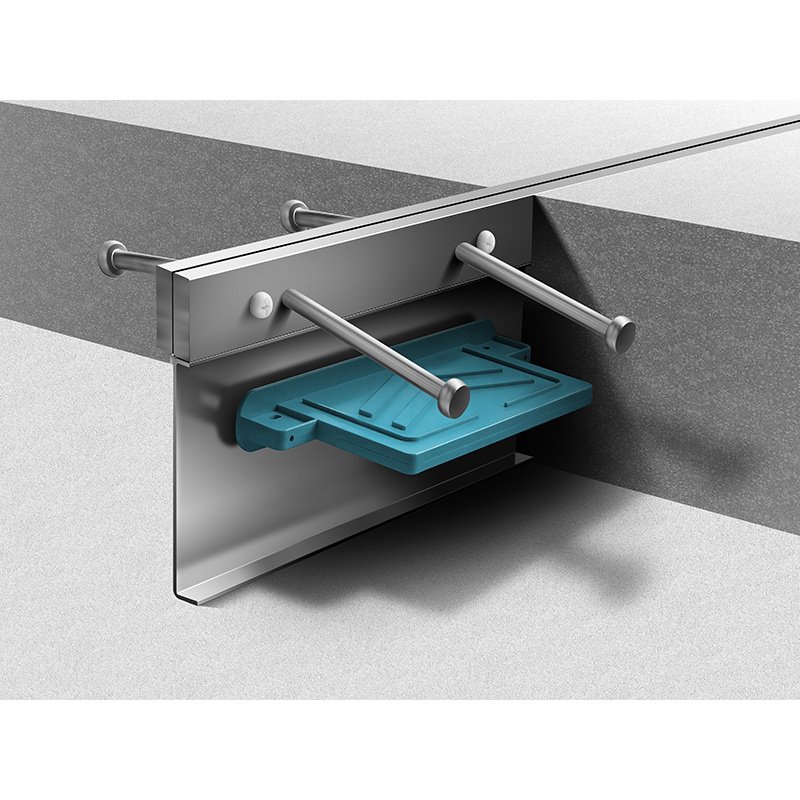
Armoured joints which also act as leave-in-place formwork are used to create a boundary in which to contain a day’s concrete pour. As the concrete sets and contracts, the two sides of the joint (held together with frangible connectors) are gradually pulled apart horizontally. Dowels fixed through the centre, stop the slabs moving vertically and allow for load transfer between the two sections of the floor. Once the floor has contracted, the gap between the two sides can simply be filled with a suitable joint sealant.
Why Use Armoured Joints at All
Construction joints are an essential part of creating a concrete floor. But left unprotected, they will quickly become damaged once the building is brought into use – leaving the building owner or operator with repair costs and expensive down-time. A damaged construction joint is more than just unsightly. Materials handling vehicles can suffer costly damage too on an uneven surface; and it can even present a health and safety issue for forklift drivers.
The best solution is to armour joint arrises during construction, to build in protection from the start. It is easy and cost-effective, and reaps benefits for the lifetime of the building.
Zhejiang Boen Metal Products Co., Ltd.
Established in 2009, factory area 17000m2.


As one of the most professional armoured joint manufacturers and suppliers in China, we're featured by quality products and competitive price. Please rest assured to buy bulk armoured joint from our factory.
macro synthetic fiber, xorex steel fiber bridge, high quality hooked end steel fiber(0/10)
