

 Language
 Language
Quick transportation
We cooperate with professional sea shipping, air and logistics companies to provide you with the best transportation solution.
Good services
Customer service will update you the logistics information of the goods in time to ensure that the goods are delivered in time.
Professional team
We have a team of skilled and experienced professionals who are well-versed in the latest technology and industry standards. Our team is dedicated to ensuring that our customers get the best service and support possible.
Competitive prices
We offer our products at competitive prices, making them affordable for our customers. We believe that high-quality products should not come at a premium, and we strive to make our products accessible to all.
Rich experience
Has a long-standing reputation in the industry, which makes it stand out from its competitors. With over many years of experience, they have developed the skills necessary to meet their clients' needs.
High quality products
We always put customer needs and expectations in the first place, refine on, continuous improvement, to seek every opportunity to do better, to provide customers with their expectations of quality products, to provide customers with the most satisfactory service at anytime.
The global steel fiber market size was estimated at USD 1.6 billion in 2018 and is anticipated to expand at a CAGR of 7.2% from 2019 to 2025. Increasing the non-structural application of steel fiber through reinforcement in the construction sector is the key factor driving growth. Steel fibers are extensively used along with mesh and steel reinforcing bars in various construction applications. Advantages including optimization in steel consumption, concrete savings, and faster construction have created a positive impact on product demand. These products also assist in quality improvement of construction through effective crack and shrinkage control and elimination of rebar corrosion.
U.S. accounted for 72% volume share of the North America market for steel fiber in 2018 and is likely to expand at a lucrative CAGR over the next seven years. Concrete has week tensile strength and hence, the addition of steel fiber provides additional strain capacity and tensile strength in concrete. The expansion of the concrete industry in the U.S. is a key driver for the regional market owing to the increasing use of the product in a structural application.
Pavements and flooring application is likely to represent numerous opportunities for market vendors in U.S. Concrete pavements can help improve fuel efficiency that travels on roads compared to other pavements. As per the Portland Cement Association, the use of concrete pavements has the potential to decrease fuel consumption by 3% and reduce Greenhouse Gas (GHG) emissions by 51.2 million short tons.
Currently, steel fiber concrete is widely used in developed countries compared to developing countries. Steel fiber as a reinforcing component has high demand in industrial flooring, logistic centers and warehouses, car parking, airports, swimming pools, and motor roads.
Strong competition from steel reinforcement bars (rebars) represents a challenge for the market. Rebar products are still widely used across the construction sector and have a higher penetration in both developed and developing economies. Rebar has wide applications in residential, non-residential, and commercial construction where structural strength is required.
Steel fibers are commonly used in reinforced concrete to improve its strength, ductility, and durability. There are several different types of steel fibers available on the market, each with their own specific characteristics and applications.
One of the most common types of steel fibers is hooked-end steel fibers. These fibers have small hooks at the ends, which improve their bond with the concrete matrix. The hook design helps to prevent fiber pullout and increases the fiber-concrete interface, resulting in enhanced performance in terms of crack control and ductility.
Another type of steel fibers is crimped steel fibers. These fibers have a wave-like shape, which increases their surface area and bond strength with concrete. Crimped steel fibers are often used in applications where high impact resistance is required, such as tunnel linings and industrial flooring.
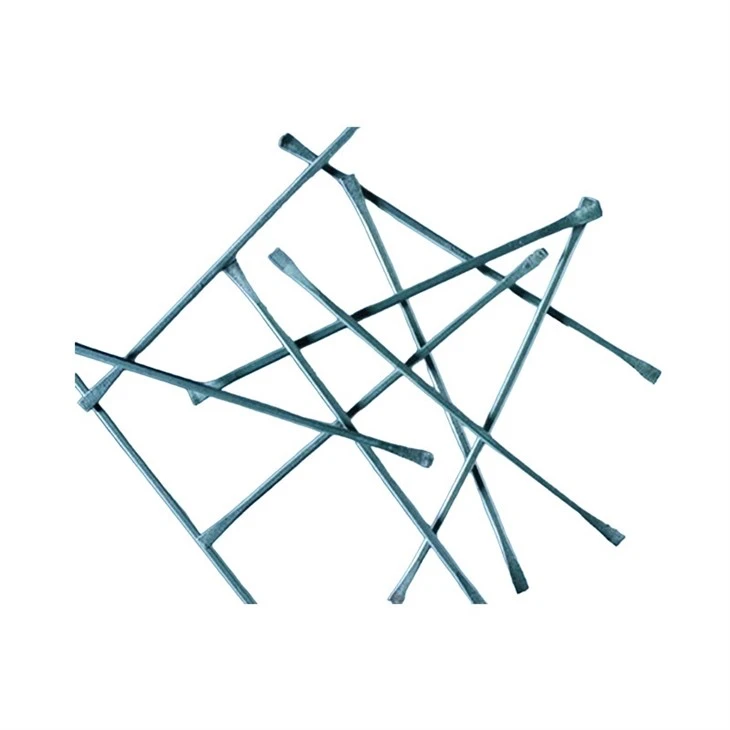
In addition to hooked-end and crimped steel fibers, there are also flat steel fibers available. These fibers have a flat cross-section, which allows them to be easily dispersed throughout the concrete mix. Flat steel fibers are commonly used in precast concrete elements and shotcrete applications, where a high level of homogeneity and workability is desired.
The choice of steel fiber type depends on the specific requirements of the project, including the desired performance characteristics, design parameters, and construction methods. It is important to work closely with a structural engineer and concrete supplier to determine the most appropriate steel fiber type for the project at hand.
Exploring the different types of steel fibers is essential for understanding their unique properties and applications in reinforced concrete. By selecting the right type of steel fiber, engineers and contractors can optimize the performance and durability of their concrete structures. Whether it is improving crack control, enhancing impact resistance, or increasing workability, the use of steel fibers offers a versatile and effective solution for a wide range of construction projects.
Construction Industry
The application of steel fiber in the construction industry is mainly used to improve the strength and durability of concrete. In high-rise buildings and large bridges, steel fiber concrete has become a commonly used building material. It can improve the earthquake resistance, fire resistance and weathering resistance of concrete, and provide a solid guarantee for the safety and durability of buildings.
Underground Engineering
In underground projects, such as subway tunnels and bridge foundations, steel fibers are also widely used. Steel fibers can effectively enhance the tensile strength, toughness and fatigue resistance of underground structures, and improve the safety and stability of underground projects.
Highway Engineering
Steel fibers are mainly used in the construction of concrete pavements in highway projects, which can improve the durability and bearing capacity of pavements and reduce the maintenance cost of pavements. At the same time, steel fibers can also increase the crack resistance and spalling resistance of pavements and increase the service life of pavements.
Machinery Manufacturing
Steel fibers are also widely used in machinery manufacturing. In the manufacture of industrial products such as automobiles, railways, and motor vehicles, the addition of steel fibers can enhance the strength and rigidity of products and improve the durability and safety of products.

Experimental Study on Steel Fiber Reinforced Concrete Using flat Crimped & Round Crimped Type Steel Fiber
Steel Fibre Reinforced Concretes are characterized by high tensile and flexural strengths and high ductility, as well as by a high compressive strength and a very good workability. Ductility and strength of concrete can be improved at lower fiber contents, where fibers are used in combination rather than reinforcement with a single type of fiber. Durability problems concerning one type of fiber may be offset with the presence of a second type of fiber. Steel Fiber is added by 1% volume of concrete. The different concrete mixesalong with control mix proportions as 100% round crimped type fiber, 50% round crimped type fiber -50% flat crimped type fiber and 100% flat crimped type fiber. Two types of crimped steel fiber i.e. round crimped type steel fiber and flat crimped steel fiber are used of length having 50mm. An extensive experimental investigation consisting of 12 specimen of size 50 x 10 x 10cm for determining flexural strength, 12 specimen for compressive strength and 12 specimen for split end test are used.In the experiment, an combination of steel fibre with concrete is used, which improved various mechanical properties and the strength. This review study is a trial of givingsome highlights for inclusion of steel fibers especially in terms of using them with new mix ratio combinations with concrete.
Mechanical Behavior of High-Strength Steel Fiber-Reinforced Concrete
Steel fiber-reinforced concrete (SFRC) is a composite material, consisting of conventional concrete with the addition of short, randomly distributed steel fibers. Fibers modify the mechanical behavior of concrete, improving some of its properties: they increase its ductility, enhance its residual tensile strength, and under certain conditions, increase its ultimate flexural strength. All these advantages make this material competitive with conventional reinforced concrete. However, the psychological barriers of the construction sector and the technical challenges that remain to be solved are slowing down the consolidation of this building material. One of these challenges is the improvement of the understanding of fatigue, which not only affects SFRC, but concrete in general. In this regard, work to date suggests that fibers, given certain circumstances, increase the fatigue life of concrete. This would result in SFRC being very effective in structures where fatigue is a critical action, such as wind turbine concrete towers.
First, look at the qualified rate of steel fiber shape. The percentage of special-shaped steel fibers that meet the factory-specified shape to the total number of fibers is called the qualified rate of shape. Except for straight steel fibers, the qualified rate of the shape of other shapes of steel fibers should not be less than 90%. 100 pieces of products are randomly selected from each batch of products, and their shapes are checked one by one. If there are broken hooks, unilateral forming and other shape defects, they are considered unqualified. The qualified rate of the shape of the inspected steel fibers should not be less than 85%.
Diameter or equivalent diameter, the deviation of the average value of the diameter or equivalent diameter of the steel fiber from its nominal value should not exceed 10%. As for the inspection of the diameter of circular cross-section steel fibers, 10 fibers are randomly sampled from each batch, and their diameters are inspected one by one with a vernier caliper. The deviation between the average diameter and the nominal value shall meet the specified deviation requirements. For the inspection of the equivalent diameter of non-circular cross-section steel fibers, the average equivalent diameter is determined by the mass method. 100 fibers are randomly sampled from each batch, and their mass is measured with a balance with an accuracy of 0.01g. The length of the steel fibers is measured one by one with a vernier caliper with an accuracy of 0.02mm. The deviation between the average equivalent diameter d(f) obtained by formula (1) and its nominal value shall meet the specified deviation requirements.
The deviation between the length of the steel fiber and its nominal value shall not exceed 10%. The inspection method is to randomly sample 10 fibers from each batch of products and measure their length with a caliper with an accuracy of not less than 0.02mm. The qualified rate of length deviation shall not be less than 90%. The average length of the 10 fibers shall also meet the deviation requirements.
Zhejiang Boen Metal Products Co., Ltd.
Established in 2009, factory area 17000m2.


As one of the most professional flat end steel fiber manufacturers and suppliers in China, we're featured by quality products and competitive price. Please rest assured to buy bulk flat end steel fiber from our factory.
flat head steel fiber material, corrugated flat head steel fiber, flat end steel fiber for tunnel(0/10)
